|
 Subscribe in a reader Subscribe in a reader
Here's
where we keep you updated on news about parenting as it relates
to division of responsibilities, career versus home decisions,
work/life balance, and legislative and grass-roots movements toward
equality or better choices for families. We’ll also throw in our
opinions of life as equal parents in a nonequal world, regardless of
what’s in the news.
Archives
 |

NOTICE:
You have reached an OLD version of this blog. To view our current
Equality Blog, please click HERE. Thanks!
- Marc and Amy Vachon
Happiness Denied
Over at The Huffington Post, author and
personal-strength guru Marcus Buckingham has been running a series of posts on his upcoming book, Find
Your
Strongest Life. I was intrigued by the premise of the first
post: women's happiness has been in a steady decline for many decades.
Sounds crazy,
huh? After all, back in the 1960s women led lives of overt female
oppression - stuck at home as men's servants, raising their kids and
scrubbing their floors - as described by Betty Friedan in The
Feminine Mystique. How could we be less happy now that we have so
many more options, and now that, in many fields, we are heading to
college more often than men and often earning more than our partners?
Any minute, statistics are expected to reveal that more women than men
are in the workforce. Even at home, things should be better now than in
the 1950s - we've got the microwave, the dishwasher, the food
processor, and all manner of other supposed time-saving devices and
conveniences. Never mind the Internet.
Buckingham
offers up interesting data from 1972 to the present as proof of his
premise, and then discusses (and debunks) several theories about why
women are now less happy (while men's happiness has actually
increased). And why individual women tend to grow less happy as they
age. He says the trend is explained not by women working longer hours
than men (in general, they don't), nor by women doing more household
chores than men (they still do, but this difference is getting smaller
- not bigger). He suggests, instead, that the trends are there because
women are generally harder on themselves than men - and that when they
take on more and more roles (homemaker, breadwinner, parent, community
volunteer, amateur cheesemaker, school committee candidate), they feel
miserable trying to balance their lives and be good enough at each role.
His solution
is to throw balance out the window. Oh no, here we go again - 'balance'
as a dirty word. But wait. I read further and notice that symantics are
getting in the way. Buckingham doesn't like the kind of balance that
has to be one-size-fits-all, perfect, this-vs-that - a tenuous and
stressful state. Neither do I. I don't choose to throw the word
'balance' away, however, but rather to define it as something much more
personal and satisfying. Buckingham takes a different route to a
similar idea - he uses different terminology to describe living in
the moment, and living your own authentic life (not
someone else's idea of what you should be doing or how much time you
should be devoting to work vs home).
Several other
journalists have reacted to this Huffington Post series. Here's one
very
good analysis of why women are less happy now - well worth the
read. Here's another that's a scathing
attack on the data, along with a rebuttal.
I
think there is a lot of truth to some aspects of the decline in
female happiness, and the reasons are complex. But I don't think the
main problem is our perfection tendencies. I suspect it has more to do
with the fact that we are living in a culture that has stubbornly
refused to catch up to our desires, and so often we find ourselves
following prescribed life paths that are wholly unaligned with our
hopes and dreams. As women, we've availed ourselves of all the
opportunities we now have but we haven't let go of our old roles enough
to enjoy the mix. And men have let us into the work world but haven't
remade their definition of masculinity enough to join us on the
homefront.
What to do?
Buckingham doesn't venture into all the governmental or corporate
policy changes that could help make it easier for every woman to be her
authentic self and live in the moment. He focuses on what an individual
woman can do for herself. In becoming spokespeople for equally shared
parenting, we've taken a similar tact. Marc and I hope beyond anything
else to give others the courage to choose the lives that fit them best
with open eyes. To learn to sidestep what our society expects of us so
that we can build our own ways of relating as partners, workers,
parents, people. For us, that's ESP - hands down. For others, that may
be a very different solution. Doing something different isn't easy.
It's often really, really hard. But if it allows us to create our own
personal definition of balance, it can make us truly happy - this I
believe.
Challenging Dads
The premise
of an NPR column
this past week was that men will take on more caretaking
responsibilities when society both expects it and demands it. Namely,
when the pediatrician, teacher, and other touchpoints in a parent's
world start treating men as fully capable and involved fathers. Men
will then feel society's stare of judgment and will be shamed, or at
least lulled, into changing their ways.
I enjoyed the author's perspective and would love to embrace this "new"
society but I'm not sure I can agree with the conclusion. Yes, I
believe parenting roles are shifting and people are noticing but I
don't think it's because president Obama is asking dads to do their
fair share or because a nurse looked at Dad, not Mom, when sending
instructions home. Instead, I suspect that society is changing "one
individual decision at a time." Despite the lack of cultural support to
do so, men (and women) are choosing differently from previous
generations. Neither want to be pigeon-holed into roles that rob them
of their ability to experience the bounty of parenthood whether it's
pursuing a career, bonding with their children, caring for their home,
or simply enjoying life.
The author challenges men to "step up" but I prefer to think a "step
back" is in order. Let's engage our partners to structure our lives in
a way that offers a sustainable chance at happiness for both. Imploring
men to do more seems a little short-sighted given the complexity of the
roles we have all assumed in recent decades.
Partner Swap
An
interesting experiment is going on over at Slate. Named Freaky Fortnight, it involves a husband
and wife swapping roles for 2 weeks. Husband Michael Agger works
full-time at Slate itself, and his wife Susan Burton stays at home and
does part-time freelance writing in between caring for their two sons,
ages 1 and 4.
The
experiment involves Susan literally stepping into Michael's job -
commuting to his office, attending his meetings, and doing the writing
and editing he would normally do. And Michael taking care of the kids
and home. At first, I was worried that this was a gimmick a bit like
those wacky ESP reality switches that were commissioned awhile back for
The Guardian and The Independent. But, thankfully, it
isn't.
Both Susan
and Michael are wonderful writers, so the writing is thoughtful and
wry. Neither is bent on playing out any bumbling stereotype - the dumb
wife who can't handle the work world or the stupid husband who can't
manage to feed the kids and get them dressed. Both have moments
throughout their days when they realize little poignancies. Susan
lovingly steps inside her husband's head as she sits in his office
chair and tries not to rearrange his desk. Michael gets in-the-moment
with his kids - able to be there for the tiniest discoveries such as a
new word one of them learns on a particular day. They appreciate the
difficulties of each other's usual roles, and each finds out new
strengths of his/her partner.
I'm really
enjoying Freaky Fortnight (entries are posted for the first week so
far). Unlike those other swaps, this one both fully acknowledges, and
also manages to get past, the unfair expectations that anyone can plop
themselves into a new role and instantly excel. That's not what Freaky
Fortnight is about. It's about sharing and intimacy and partnership.
Walking in each other's shoes.
Just one of
the perks that ESP offers every day.
An Equal Future
Over in the
UK, the Equality and Human Rights Commission (EHRC) is tackling the
issue of making sure that there are adequate numbers of skilled workers
available to meet the demand as more people reach the standard
retirement age of 65. Of course, this predicament is not unique to the
UK - there are similar concerns in the US and elsewhere. However, I
find it refreshing to hear public discourse on the topic.
I like the
concept of companies tweaking the "standard" work week to attract and
retain skilled employees. Maybe baby-boomers will want to stay in a
workforce that allows for more flexibility while encouraging meaningful
contributions. Perhaps caregivers, parents and down-shifters would like
the same options? I see potential for creating a vibrant, dedicated,
flexible workforce comprised of all types of adults that companies
could embrace.
The Guardian
(UK) ran a column recently outlining the
scope of work for the EHRC. Here are some of its goals:
"Britain
cannot afford to go on asking people to fit their families around the
demands of ever-more intense 24/7 global competition, and marginalising
or rejecting workers who fail to fit into traditional and inflexible
working arrangements."
"As part of
the first phase of Working Better, which focused on families, we found
that today's parents want to share work and family more equally, and
that there is extensive unmet demand from fathers for more leave with
their children."
"We have
proposed the current model be replaced with a world-class policy of
gender-neutral parental leave by 2020."
"The
challenge for government and for employers is to take advantage of
these changes by showing a real commitment to flexible working. Only
then will we be able to capitalise on the full diversity of talent
available to us in 21st-century Britain."
The UK is
apparently getting comfortable with the discussion of real, normal,
flexible workplaces. And I am encouraged that the policies being
discussed are often without reference to gender or parental status. I
firmly believe it is possible to establish a workforce that can meet
both the demands of business and the desires of all workers.
Unhealthy Kids? Blame Mom, of Course
The BBC News
aired a segment
on Monday that examined data from an Institute of Child Health study of
5-year old children. The study looked at the eating habits and physical
activity level of 12,500+ kids, breaking them into those with
stay-at-home mothers and those whose moms worked at least part-time.
The findings? Working moms make kids junk food snackers and couch
potatoes. The study's lead author hypothesizes that working moms don't
have as much time as SAHMs to devote to providing healthy snacks and
limiting TV watching.
What about
the dads? The researchers wave them away as background noise. They
didn't examine men's work hours because these haven't seemed to change
whereas women's work hours have. This argument doesn't make much sense
to me, unless they really mean that they could not find a large enough
cohort of stay-at-home dads to include in the study.
But the
bigger issue is why this kind of research continues to be conducted and
then promoted as 'blame the moms' fodder. Father employment levels may
not have changed as much as mother employment varies, but father involvement
sure has changed. And what if parental involvement counts more than a
'yes/no' response to a "Do you work?" question?
Parents who
haven't got time, or energy, or knowledge, or inclination, to care what
their children are eating or doing will probably raise children who eat
more chips and log more tube time. Parents who have chosen to balance
their lives (regardless of whether this includes working) and care
about these issues will take the steps to teach their kids to lead
healthy and active lives. With ESP, for example, both parents have
plenty of time with their kids (together at least as much as a SAHP
would have, in most cases), and they are both equally competent to
handle the nutrition and exercise issue every day.
Can we stop
blaming the moms and ignoring the dads?
Hat tip to Melissa
for sharing this news.
Angry Wives with a Plan
If you
recall, Parenting Magazine published a piece in January called Mad
at
Dad. They did a good job riling up the masses of women who are
fed up with their lives in large part because they feel burdened with
the roles of primary parent, homemaker, and often co-breadwinner as
well. I have to admit that this would get me mad as well. At the time,
we blogged
about this piece with some suggestions for moms.
Since then, Parenting Magazine has garnered their own advice for moms
to get past the anger. We were honored to toss in our opinions and
really like the resulting piece
released this week. Here are a couple points from some of our favorite
mentors:
"First, recognize that equality is an
attainable goal," says Francine M. Deutsch.
"You want to feel like you're
solving things together instead of having dump-on-Dad time," says
Pepper Schwartz, Ph.D.
Luckily, we don't sound too
shabby either:
"Involve your husband as your partner, not your employee. Ultimately,
this is a gift to your children," says Marc Vachon. "Moms and dads are
different, but they both need to be equally valued," he says.
"The more you can build the
sharing into your schedule, the less it becomes a contentious issue,"
says Amy Vachon
Hopefully, this will get
people focusing on the solutions instead of the problem.
In the End, What Really Matters?
Warning: I'm
feeling rather philosophical - make that downright spiritual. I've just
finished reading Arlie Hochschild's The
Time
Bind (her 1997 follow-up to The
Second
Shift), which of course I should have read long ago
but, well, didn't. I'm actually not sure I would have appreciated it as
much if I'd read it a few years ago, so I'm happy to have devoured it
now. Or rather, I'm glad I waited to have the nightmares I'm now having.
The
Time
Bind is like that old horror movie (and book) about
conformity, The
Stepford
Wives, in many ways - only it's real. It follows Dr.
Hochschild (sociology professor emerita at the University of
California, Berkeley) into a seemingly ideal, top-rated Fortune 500
company she re-names Amerco to protect the innocent. There, she is
granted in-depth interviews with anyone she wishes to meet, from top
brass to midnight assembly line workers. She follows them home and
interviews their spouses, observes their children, and offers a
therapist's view of what is really going on in their heads as they work
themselves to the bone and sacrifice the well-being of their families
at the same time their company offers them all sorts of work-life
balance perks they generally ignore.
"What's going
on here?", Dr. Hochschild sets out to answer. Not what many of us might
think. The answers are chilling, and so completely sad. The Amerco
employees work because their company has become their real home - much
simpler, much more instantly gratifying or at least palatable than
dealing with the messiness of home, kids and partner. They work because
the work culture at Amerco has brainwashed them into thinking that work
is w-a-y more important - often the only important thing in their lives
- than the stuff that really counts. They've drunk the KoolAid that
proves they are devoted workers first, and that...oh, well, yeah I have
some kids but that's beside the point. They think that a balanced life
is a crazy notion - or something they'll find a way to have at some
future date, with some fictitious version of themselves they cling to
but don't value by actions.
Amerco is
American business. It is all the well-meaning but
capitalistic-success-driven companies that offer flex schedules and
work-from-home options and reduced hours that maybe 1% of employees
dare sign up to take. It wants workers to be happy, and it feeds them
its own brand of happiness in a 'workplace culture' that makes us
forget we are people, parents, brothers, sisters, lovers, friends,
neighbors too. It values face time, not results (even as it often says
differently). It forgets that sometimes the best workers are those who
are actually free to see their kids and cultivate happy marriages. And
in this downturned economy that has those of us who are still employed
working scared, it is alive and well.
Along comes
the President of France. As described in the terrific new Work.Life
blog over at True/Slant, Mr.
Sarkozy is challenging nations (nevermind simply corporations) to think
completely differently about their value. He's suggesting that instead
of measuring the success of a country by its economic output, we also
measure this by the general well-being if its citizens. In other words,
happiness could possibly count for something! Imagine a world where the
end goal wasn't how many things we buy, consume or produce. A world
where a 'rich' country afforded its citizens more leisure and time with
our families rather than a chance to work yet harder with each passing
year.
Mr. Sarkozy's
brilliant ideas will probably come to nothing. They'll end up in some
metaphoric landfill somewhere, buried underneath the stuff we've
consumed that took long hours at work for us to earn. After The
Time Bind, I'm cynical.
But, at least
for each of us personally, I'm very hopeful. With ESP, we chose
differently every day. It gives us a chance to do good work, the
ability stay connected intimately with our families and remember that
this is our greatest joy, and the option to align our lives with what
we each truly value most.
Feminism and the Immersed Parent
What a joy to
read a recent post by Backpacking
Dad called Feminism and the Immersed Parent. He cleverly argues
that women who continue to perpetuate either the myth, or reality, of
their bumbling male partners actually do a disservice to the goals of
feminism. I couldn't agree more! He utilizes an analogy of men
ridiculing women in the workplace a couple of decades ago and how that
behavior has uniformly been rejected by society to the point of being
used as a grounds for determining a "hostile work environment." I would
suggest that the effectiveness of this terrific analogy proves the
persistence of gender inequality: men own the work domain and women own
the home domain.
Obviously,
culture plays a huge role in the behavior that we each consider daily
despite our wishes to do otherwise. Women in the US without shaven legs
do so intentionally regardless of the expectation and men don't tend to
wear skirts partly due to similar expectations. However, being
genderless doesn't necessarily "solve" the problem either. Many
same-sex relationships can attest to that. If gender isn't the deciding
factor for family decisions perhaps earning power, geography, interest,
or expediency will be used instead. Without the unemotional framework
of what equity might look like we are likely to miss the mark for any
number of reasons.
Unlike the
ESP model, Backpacking Dad doesn't continue to push equity down to the
details of our lives but instead allows the intention of equity to
suffice. "An immersed parent doesn't have to be the one doing the
cooking or the cleaning, but will care that the child is receiving good
nutrition and living in a clean environment. An immersed parent doesn't
have to be the one singing lullabies at night, but cares that the child
sleeps well. An immersed parent doesn't have to be the one to attend
school board and PTA meetings, but cares about the quality of education
the child receives."
Of course,
these statements are mostly true. Sure each parent should be fully
emotionally invested in his/her role as parent in all aspects. But if
an "immersed parent" never cooks, cleans, sings lullabies OR attends
PTA meetings, full equity has little chance of prospering. Time
is the frontier feminism could embrace. Equivalent time pursuing a
career, equal access to experience the wonder of childcare, sharing the
responsibility for the home and jointly creating opportunities for
rejuvenation.
I expect that
there are quite a few men, and women, who could embrace that model.
Parent of Record
Now that
we're in the thick of the back-to-school season, it's time to fill out
all those forms sent home with our children that ask for our names,
addresses, cellphones, emails and places of work. Oh, and that
determine which parent will be the lucky recipient of those automated
phone calls alerting us to our children's tardiness, absences, the
school spirit day family gathering, the next PTO meeting, early release
days, the start of the book fair and bake sale, and any number of other
announcements. Who to pick? Mom, as usual? Dad, just to freak out the
school secretary? Both (but that could be rather inefficient for you)?
We've
typically defaulted to me as the parent of record, only because our
work schedules mean I currently do more of the drop-offs and pickups
than Marc does. But that does leave me either holding the
responsibility for taking care of the news, or feeling petty for
passing on this job to Marc when it is so easy to handle myself.
At T's
school, we're both listed on the general contact list. And at M's
school, I'm the auto-call recipient but both of us appear on the class
contact list (the only set of parents on the list, by the way).
Today, one of
T's friend's parents called Marc's cellphone with a birthday party
invitation. Since calls like this usually come to me, he hesitated a
few seconds before diving in to check our schedule, tell me about the
event, and then respond with a "yes, T would love to come" and book the
date. His hesitation? Men don't own this stuff - they pass it on to
women to do. Recognizing his slight urge to pass it on was interesting
for Marc to observe and then push past.
How do you
handle the 'parent of record' issue?
Can We Say "Enabling"?
Oh, no! Mom
is going away on a business trip. How will Dad ever make it at home
alone without her direction? Will the kids go hungry? Eat only junk
food? Leave for school unwashed, uncombed and in badly matched outfits?
Be abandoned at the end of the school day because Dad forgot to pick
them up?
These are the
worries of a female work/life balance expert in a recent Working
Parents
blog entry (a parenting blog we usually love). To combat
her fears, she suggests that moms plan ahead before boarding that
plane. Start with a well stocked pantry - one full of fully prepared
meals rather than individual fresh ingredients so that your hapless
spouse can simply heat them up. Then, make sure you've got plenty of
paper plates and plastic utensils on hand, because God knows a man
can't be expected to wash dishes and feed the kids. Next,
leave out explicit instructions about when each child needs to be where
every day. Add in emergency contact numbers because, well, he surely
should not be expected to know or find these on his own.
Then, prepack
the diaper bag and kids' backpacks (he would never do this right). Wash
the kids' clothes so, heaven forbid, your poor kids won't be without
their T-ball shirts on game day because your husband couldn't possibly
be expected to think ahead for this responsibility. Then, and only
then, you'll have a shot at relaxing during your business trip -
knowing that the kids are okay because once again you held up their
world.
The blog
author actually forgot a few useful tips. She should have filled up his
car with gas, laid out her husband's outfits for the week, called his
work colleagues to make sure they reminded him to get to the office on
time each morning, left him messages explaining how and when to brush
his teeth, and alerted a neighbor to stop by the house each day to make
sure he's moving his bowels.
Pardon
me...the lack of subtlety in the Working Parents blog entry carried me
away for a minute.
This
work/life balance writer seems proud of her tips. I'll bet she also
hopes for an equal partner in raising her kids. Yet she sabotages her
chances at such by treating her husband like a child so that she can
relax on her business trip - because she remains in control. She takes
on a huge amount of extra work, but the work is easy compared to the
discomfort of letting go and actually allowing her husband to take on
any decent parenting responsibilities.
I'd be
embarrassed to be treated this way.
Letting Men Into the Experience
We've said
countless times on this blog that women who want to share in the work
of parenting with their partners need to let go of running the show at
home and with the kids. Don't make more than your share of household or
childraising decisions, don't direct your husband or belittle his way
of handling the kids or chores, etc. In fact, we've said more than once
that there are only a couple of things that you can't share as a mom:
pregnancy, childbirth and breastfeeding.
Well, maybe
you can share these too. Not physically, of course. But
sometimes the most important things aren't confined to the physical.
Take pregnancy, for instance. It's pretty common for pregnant women to
kind of fold in on themselves and take in all the changes going on in
their bodies - the wonder of those first fluttering movements, the
cravings and repulsions, the careful eating, the strange aches and odd
proportions and unique clothing requirements. Sure, they might involve
their partners peripherally by letting them know when the baby is
kicking or inviting them to join in at an ultrasound visit. But they
typically focus on the pregnancy as theirs alone - later, the baby will
be shareable.
All of this
woman-focused baby-making is understandable. Yet, in a very small way,
it sets the tone for the future - or at least it can. "My baby" can
become a way of thinking that extends past birth. And it allows the
woman to slowly become better prepared, emotionally and mentally, for
motherhood over 9 months - while her husband can more easily ignore the
enormous life change in store until, say, he attends childbirth classes
with her. Or maybe until the day their baby is born.
Joe Kelly,
aka The Dad Man, advocates in a recent blog post that men and women
think of their baby as 'theirs' from the first moment they know they
are expecting. He suggests using language like "we're expecting" and
even "we're pregnant" rather than "she's expecting" or "I'm pregnant."
You may object - in fact, I can see pregnant women out there rolling
their eyes and saying, "Hold it right there, honey...we're not
pregnant...I am." And then sending their husbands out for mocha fudge
brownie ice cream. But Joe is onto something. Yes, for the next few
months, a baby is growing inside of one of you and not the other. But
if you want that baby to grow up in the equal care of both of you,
perhaps the experience of anticipation can be a primary focus for
now...and this can be fully shared.
Score and Win?
Working
Mother magazine has a new online 'test' that allows you to
compare how much housework you are doing with how much your lazy...I
mean, sweet...husband does. In Cosmo style, you're invited to add up
your points on such tasks as:
Tossing
the two-week-old takeout from the refrigerator. 1 point
Scooping
up
scattered toys. 2 points
Washing
the funk out of a sippy cup you found in the backseat. 5 points
Scouring
splattered
tomatoes sauce off the stove. 2 points
Walking
the dog. 1 point
Walking
the
dog in the snow. 5 points
And so on.
Then, you're invited to tally your score against that of your spouse
and the veil is lifted. Ding, ding, ding. We have a winner!
Now isn't
this just what we don't want to do if we're aiming for
equally shared parenting? Who actually "wins" when one partner proves
she's doing more? This kind of scorekeeping may serve to shed some
light on a problem that both spouses already know deep (or not so deep)
down, but it sure doesn't set the tone for solving it. Besides being a
cute, far-from-validated test of unequal household labor, it takes a
partner-based lifestyle like ESP and turns it into a he said/she said
contest. Blech.
The rest
of the article that contains this test is actually pretty good. It
enlists the help of our beloved mentor, Francine
Deutsch, who points out that couples should aim for equal time
spent doing chores rather than picky individual chore division by
so-called expertise. Dr. Deutsch also advises skipping old gender
assumptions when choosing chores, approaching the issue with a spirit
of cooperation rather than fighting, pointing out the benefits to your
spouse of equal housework, not micromanaging his involvement, and
meeting together to evaluate how things are going to tweak them over
time. Amen to all of this.
p.s. One more nagging thought. Granted, the average person might
consider walking the dog in the snow to be more onerous than doing so
on a beautiful summer day. But is the weather really the sole
determinant of our ability to approach a task with joy? I can imagine
someone (not necessarily cat-loving me) who might actually like
strolling down a quiet, snow packed street with his dog. As the saying
goes, "One man's trash is another man's treasure." Time is the only
impartial measure of dividing chores. Go ahead and make the best of
your own to-do list.
What Do Women Really Want?
I was
flipping through the Harvard Business Review at work today when I found
an article called Understanding
the
"Female Economy." It was written by a man and a woman who
wrote the forthcoming book, Women
Want
More: How to Capture Your Share of the World's Largest,
Fastest-Growing Market. The article documents the main areas
of opportunity for businesses to sell their wares to women who
apparently make the purchase decisions for "94% of home
furnishings...92% of vacations...91% of homes...and 60% of automobiles."
The authors
also conclude that women "have too many demands on their time and
constantly juggle conflicting priorities - work, home, and family."
Their solution is for companies to focus on "time-saving solutions or
for products and services designed specifically for (women)."
The
strategies make perfect sense from a business perspective but from a
practical or personal view none of these supposed products or services
will help women or men get what they really want...a partner. Sure,
they can save a few minutes with some fancy new gadget or streamlined
grocery or dining options but if they continue to own most of the major
purchase decisions around the home, not to mention much of the actual
work that needs attention, satisfaction will continue to be elusive.
Henry
David
Thoreau weighed in on this issue about 150 years ago in Walden:
"I
say beware of all enterprises that require new clothes, and not
rather a new wearer of clothes."
The Name Conundrum
After we had
turned in the first draft of our manuscript, our editor asked us how we
wanted to print our names on the book's cover. Would we be Amy and Marc
Vachon, Marc and Amy Vachon, Amy Vachon and Marc Vachon? Seems like a
simple query, but we know it is actually a mini-minefield.
Over these
past few years, we've gotten used to the occasional question about why
we've placed one of our names before the other, or why Amy chose to
take my name when we married. After all, we're all about bucking
tradition. So why do we sometimes sound like Ozzy and Harriet when it
comes to our names?
There's been
plenty of discussion elsewhere about how no perfect naming solution
exists for parenting couples (either for themselves or for their
children). Many ESP couples indeed do buck tradition - giving one child
a mother's surname and the next a father's, or making up a new last
name that combines the two names, etc. Many ESP moms keep their maiden
names, some take their husband's last name as a new middle name (with
their husbands doing likewise)...and some do as we have done by
appearing to stick with tradition. Truth be told, our shared last name
of Vachon just felt right to both of us. Amy had several reasons for
wanting to shed her previous name, and genuinely loved my family's
surname. We both like the idea, for us, of sharing a last name. It's
our team name, and ESP is all about being a team together.
So back to
the 'simple' question of how to appear on our book cover. Do we go with
the classic feminist (and in this case, alphabetical, too) approach of
'Amy and Marc Vachon,' or do we perhaps separate our names to retain
our individual identity, or is there something meaningful about my name
appearing first...something that might draw attention to the idea that
equally shared parenting is not just a woman's desire (as so much of
the parenting literature is positioned) - that it appeals equally to
men.
In the spirit
of Team Vachon, we decided to go with joined rather than separate
names. But who appears first? This book was written by both of us. The
order of our names doesn't matter to either of us; what's inside - our
message - is the key. And our equality message is neither 'women first'
nor 'men first.' In the end, we took a very scientific approach. We got
out our highly calibrated equality data collection instrument and flung
it high in the air. "Heads," we called.
It will be
'Marc and Amy Vachon.'
Taking Responsibility for Equality
Last month, I
happened upon a blog entry at The Momoir Project
from an ESP mother who is very thankful for her arrangement. It was a
pleasure to read, but I was even more moved by one of the comments left
on her entry. The comment was from another mother who has found herself
in a much more traditional relationship. But rather than simply
complain, she is extremely thoughtful about how she might have gotten
there. Here is her comment, which I think is so beautifully written
that I don't want to paraphrase it:
"Somewhere
between
dropping my wedding dress off at the drycleaners and extracting
myself from the cocoon of my warm bed to nurse [my son], I lost a piece
of myself. I stopped listening to Ani DiFranco and my dreams of taking
down the system were exchanged for conversations about sleep and
aspirations to find time for myself. I became wife and mother. Like
stepping into a pair of yoga pants, I fell into the comfort of my
roles. I took motherhood seriously and appointed myself chief caretaker
queen without stopping to assess how this would all play out.
Now, two
children under four later, I sit uncomfortably on my throne and I feel
the hot orange wave of resentment as I drag my knackered spirit out of
bed to get up with the kids by myself for the 250th day in a row since
[my son's] birth. I've talked to friends who report that whoever hears
the kids first gets up with them or that they simply take turns. I muse
over what kind of miracle needs to take place in order for me to be
able to sleep in. I sit silently and wonder where it all went wrong and
how I ended up being the one who is constantly giving to everyone else
around her at the expense of her own sanity. When did I become this
person who can't negotiate her own needs? When did I become the kind of
wife that lapses into the role of mother to her husband? I can't count
the number of times I have said, "shh, Daddy's still sleeping."
Somewhere between loads of laundry and wiping noses, I embarked on a
journey to take care of everyone else's needs leaving my own almost
unfulfilled. Should I be surprised
that nobody has magically appeared to take care of them for me?
What is
probably the most baffling part of all this is that I'm not married to
some kind of uncaring lout who is unconcerned with my happiness and
well being. Far from it. I'm married to someone who loves me deeply,
someone who is happier when I am happy. And yet, somehow we have been
delivered to a place that serves neither one of us. When we play the
game of kid swap on weekends, we come together beautifully as a
parenting couple. But recently when I listened to Ani DiFranco, I had
my own mini Aha moment. She sang "and you will take the heavy stuff.
And you will drive the car. And I'll look out the window and make jokes
about the way things are." If I have misplaced small parts of myself
then it is up to me to find them. If I want a tag team approach
[meaning ESP approach, in this context] to parenting 100% of the time
then I need to take the wheel and stop making jokes about the way
things are."
It's Amy
again. I love this mother's writing because it exposes how most of the
world tends to approach why ESP is so rare - as a rude joke against
women. "It's not fair that we're stuck with all the burden!" so many
women and mothers scream or cry or laugh with sarcasm. Yet the problem
is far from that simplistic. We are not just victims - of our husbands,
of men in general, of even our culture. We're part of why
things are not equal. No need to blame women, of course. But we do need
to be at least half of the solution. We need to take responsibility,
take action, take the wheel - and stop passively accepting the standard
path for couples...it will lead to inequality, of that we can
be sure. It is up to us, together with our partners, to turn that wheel
toward ESP.
Child's Play
Our 7-year
old daughter, M, came home from camp the other day and excitedly showed
us a new hand-clapping game she'd learned. The lyrics started with:
A-B-C
It's as easy as 1-2-3
My mama takes care
of me
My daddy watches MTV
Really?
We joined in
her enthusiasm, and she taught us how to clap along. But later, we
laughed together as a family about how those words don't make too much
sense for us...how maybe 'my parents take care of me, sometimes we all
watch TV' might work better.
It's a silly
rhyme - not worth mentioning, right? In the grand scheme of ESP,
probably not. But when our kids are subtlely buying into the idea that
it's perfectly normal for moms to do all the caregiving and dads to
tune out the family, we're setting up the next generation to
unconsciously act out this age-old inequality (with both parents
missing out on a lot of fun).
Book Update
We began
writing the ESP handbook about a year ago. Much of the doubt, false
starts, and anxiety are distant memories as we enjoy the march toward
publication, scheduled for January 5, 2010.
Back in June
2008, Lisa Belkin brought ESP up for discussion with her cover story on
the NYT Sunday Magazine called When Mom and Dad Share
It All.
We heard many of you excitedly weighing in saying that you lived this
way too. In turn, we interviewed close to 50 couples who wanted to
share their flavor of ESP in hopes of bringing the priorities of an
equal partnership and a balanced life to anyone who wanted to listen.
We are
honored to have Lisa Belkin kick off the topic again with the Foreword
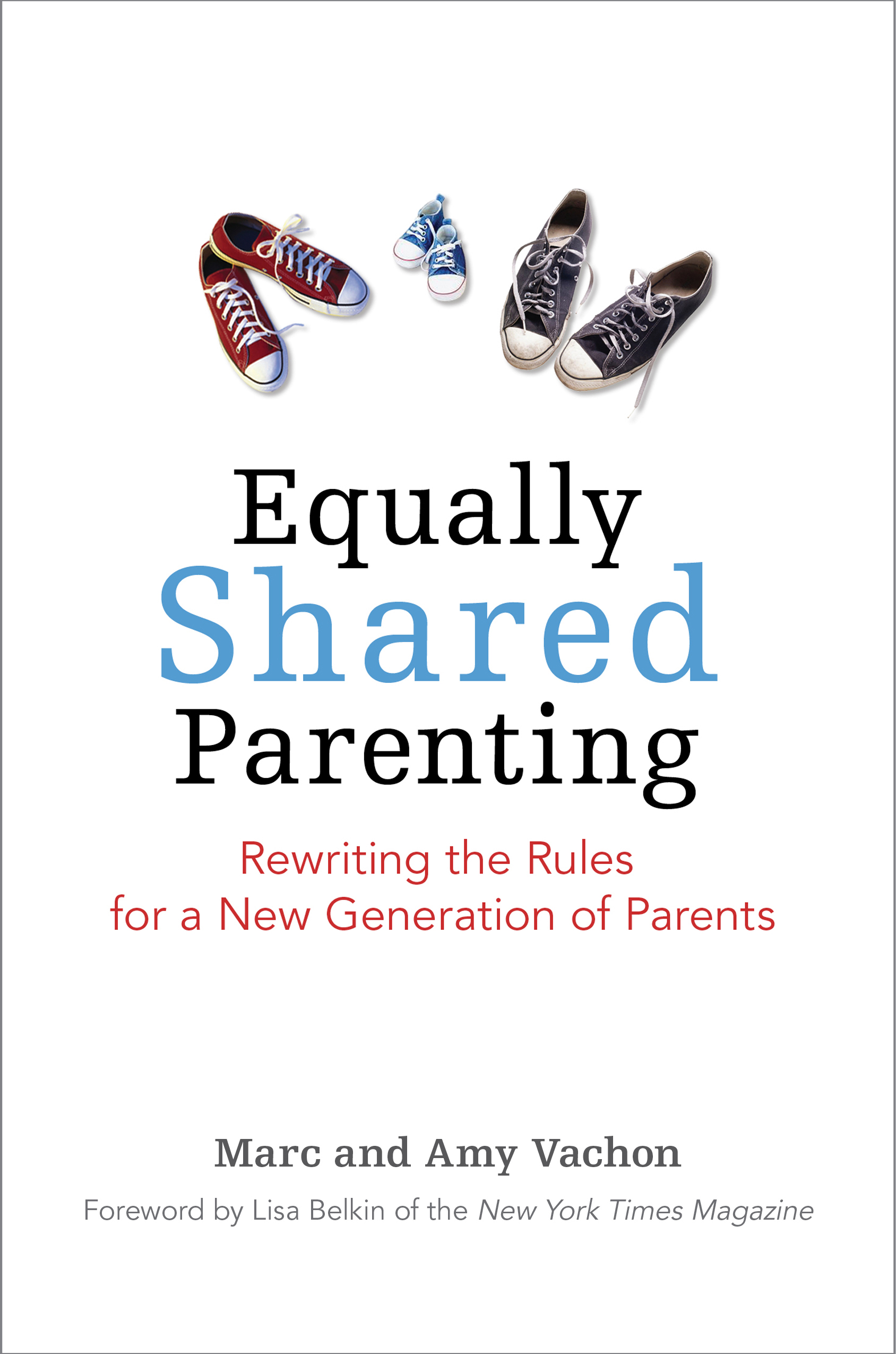
and are happy to reveal the cover
that was recently approved by Perigee, an imprint of Penguin Books.
Guest Blog: Don't Let Old Gendered Power
Trip You Up
In the wide,
wide blogosphere, there's something for everyone. Countless parenting
blogs are now entertaining us and giving us a glimpse into the private
family life of so many. But it is a special treat when you run across a
blog that fits so perfectly with your own - matching thoughts, same
concerns, similar ideas. With respect to this Equality Blog, we haven't
run into such an animal (although we follow a growing list of wonderful
blogs)...until very recently. Anne Mahoney, Professor Emerita of
Sociology at the University of Denver, has started writing together
with Carmen Knudson-Martin, Professor and Director of the PhD program
in Marital and Family Therapy at Loma Linda University, at Equal Couples, and we are so happy to
welcome them to the world of blogging. We've recently reviewed their new book, Couples,
Gender,
and Power, and now welcome Anne to ESP.com as a guest
blogger. Anne...the microphone is all yours!
Don't Let Old Gendered
Power Trip You Up
by Anne Rankin Mahoney,
PhD
In the 21st
century when most women, including mothers, work beside men in the
labor force, it seems obvious that men should also be working beside
women in the family. Nevertheless, this part of the change has not
really happened on a large scale. Research shows that men do more
family work than their fathers did, but still way less than their
wives. Why hasn't the shift to equally shared families happened with
the same speed as other 21st century changes like Internet shopping or
textmessaging?
A big reason
is that family equality involves a major power shift. For generations,
families have been organized around gender. Women took care of the home
and this "women's work" (in spite of all the nice things everyone said
on Mother's Day) was considered lower status. As long as men just
"help" women with housework or kids, they can keep a distance from
women's work. When they "share parenting," they're doing it. Men who
have overcome this old-fashioned attitude about family work have
discovered that the shift positively affects them in a variety of ways.
Marc regularly regales us here about the joys of equally shared
parenting.
If we want an
equal relationship and equally shared parenting, the first thing we
need to do is become aware of the ways old gendered power can trip us
up, despite our best intentions. For generations, men have been and
felt entitled and women have served. If we want equality, we can't just
say we are equal. We have to understand how the system has been, and
still is, stacked against equality. And we have to do a lot of talking
together to search out the ways in which those old gender roles are
still stuck in our heads.
Then, we have
to throw them out.
Careful What You Wish For
That's the
warning sent out to men by Sasha Brown-Worsham on Babble a couple of
weeks ago. She is speaking to any man who says he would like the
opportunity to swap places with his stay-at-home wife. As it turns out,
her husband gets laid-off and they get to experience a partial role
reversal for 5 weeks. The article
covers much of the expected struggles that he faces and does a great
job highlighting some of the more difficult aspects of parenting young
children.
The author's husband was a motivated father who wanted to be home and
to succeed. He brought creativity and energy to the experience but he
never got to the same level of competence as his wife. Maybe this was because she remained so available
to rescue him.
Regardless, the article does a tremendous job framing up some of the
challenges of traditional arrangements, namely, that specializing in
either childraising or
breadwinning leaves a lot of potential joy on the table from the
minimized domain.
As commenters weighed in on the piece it struck me that nobody even
referred to my favorite line, which happened to be the last sentence,
"And somehow amidst this terrifying economic crisis we have been given
a gift we never would have received otherwise: true equality."
Hopefully, other couples given this opportunity will be inspired to
reach for this kind of lifestyle beyond the trial period. It's
possible, sustainable, and worth the effort.
Babble Spotlights ESP
Welcome,
Babble readers!
We're thrilled to be featured today on Babble, the hip online
parenting magazine we've been long impressed is actually written for
both parents. Author Amy Kuras rounds up seven tips for
achieving equally shared parenting and covers key concepts such as:
- ESP is
not about task division. It isn't about getting lazy men to do more
around the house. It's about giving both partners a chance at a happy,
balanced life.
- Flexible
work
schedules, which are necessary to achieve ESP for most families,
are possible even in times of national economic stress. Keeping the
brightest and best workers by offering them the flexibility they need
can be a bargain to employers compared to letting them go, recruiting
and training others, and letting those go when they don't perform as
well.
- For ESP
couples, maximal income is far less important than optimizing their
lives as parents, partners and individuals. Work fits into their lives,
rather than the reverse, and they are willing to make the
sometimes-tough changes needed to live by their principles.
- Two
fully competent parents at home is a beautiful thing! For the kids, for
the parent who can take a break from the action without preparing for
her/his absence, and for the parent who knows he/she can handle what
comes along - and even relish it.
- Communication
is
king in ESP families. All couples fight or disagree (and that
definitely includes us!), but all the communication that ESP couples
tend to build into their daily lives may prepare us for more effective
problem solving together. Just a theory, but it makes sense.
- The
core of ESP is a team mentality. A happy partner is your best shot at a
happy partnership...and that's why we're doing this marriage thing
together in the first place.
Hearty
applause to Amy Kuras for hitting the ESP highlights so well. Choosing
a life of equally shared parenting is not always easy, but it is nice
to read in Babble a bit about why it's so worthwhile.
Book Review: Couples, Gender, and Power
I just
finished reading the new book Couples, Gender, and
Power,
edited
by Carmen Knudson-Martin (Professor of Marital and Family
Therapy at Loma Linda University) and Anne Rankin Mahoney (Professor
Emerita of Sociology at University of Denver). The book is an academic
text that pulls together a group of sociological studies to provide
guidance to marriage counselors and others who work with couples so
that they can think in fresh ways about relationship issues that might
be arising from power differences based on gender.
Each
chapter in Couples, Gender, and Power examines a new
sub-topic or population of couples (e.g., young American marrieds,
same-sex couples, couples in Singapore (a culture that emphasizes
collective rather than independent goals), African American couples,
first-generation immigrant couples, couples in Iran (patriarchal
society). And each is packed with interesting ideas. I will take up
just a few of the book's key points in this post. But if the overall
topic interests you, I urge you to get a copy! Couples, Gender,
and Power is a welcome addition to our Resources page - an extremely
useful compendium of the social research on ESP to date.
Okay, on
with my thoughts on some of the key messages....
By way
of background, the authors provide evidence that gender 'norms' mess
with our relationships - and we often don't notice them for what they
are: limiting stereotypes we can learn to see and discard. And that
classic gender roles are social constructs that result in a power
difference between opposite-sex couples that can erode a relationship
over time. Knudson-Martin and Mahoney point to solid data that describe
egalitarian relationships as the most successful, intimate and stable.
And to an imbalance of power as a motivator for both partners to hide
thoughts and emotions, making intimacy difficult and lowering
satisfaction.
The
authors define equality as something far bigger than a couple sharing
the load of dishes and laundry - and I could not agree more.
Relationship equality, the authors say, has four dimensions: relative
status (mutually defining what is important in your relationship),
attention to the other (being emotionally present and
supportive to your partner), accommodation (both partners
organizing their lives around each other to an equivalent level), and well-being
(sharing the burdens and supporting the well-being of each other).
Of
particular interest is a chapter that describes a study of young
American couples (mostly childless), and introduces the concept of the myth
of
equality. These couples all spoke of having equal
relationships, but upon examination, most did not. They used words like
'give and take' to imply equality, even if one person gave more and the
other took more. They spoke of having 'free choice' to each be his/her
own person within the relationship, and looked upon resultant
inequalities as simply arising from choice. They expressed 'all for one
and one for all' as a shared belief that explained how decisions that
benefited one partner more than the other were fully mutual. And they
referred to themselves as 'partners' in a way that implied mutual
decision making without the action behind it. All of this talk, the
researchers found, acted as a symbolic representation of the couples'
commitment to an equal relationship, but didn't often translate into
actual equality. They called this the language of equality.
I've seen plenty of this, often in reaction to media pieces about ESP,
in which commenters say 'Doesn't everyone share these days? What's so
special about ESP? We share everything, but it only makes sense for my
wife to do the cooking because she likes it better.'
This
chapter goes on to define the strategies that these equal-in-words-only
couples use to deal with the reality of their inequality. Namely, they
avoid the issue by:
- rationalizing
inequality
as a positive ("She's better at running the house." "I don't
mind doing all the laundry.")
- not
examining the consequences ("We've never discussed moving, since my
business is here.")
- settling
for
less ("I don't mind doing all the straightening up but draw the
line at doing his ironing.")
- hiding
the issues (e.g., through humor)
- placing
responsibility for equality on the wife (e.g., by making it necessary
for her to appreciate the work her husband did in order for him to keep
doing it...our point exactly in Marc's previous posts on appreciation!)
The chapter
ends by describing a way out of this myth of equality - through open
negotiation, fighting (yes, although hopefully with respect), and
working through power struggles rather than avoiding the issues. If a
couple is willing to risk the unpleasant moments that will arise by
confronting the problem, they have a chance at true equality - or at
least at knowing the truth.
Interestingly,
a
study of Singaporean couples in a subsequent chapter showed a very
different result. There, in a collectivist culture that discourages
individual goals, dual-income couples speak of being traditional but
actually act far more egalitarian. This is termed the myth of
traditionalism. Why would this be? Collectivism truly is 'all for
one and one for all.' In Singapore, it seems that young couples tend to
marry their equals. They also highly value family needs, rather than
the individual needs of one partner. And they are built for a team
mentality...perfect for ESP.
Marc and I
had the pleasure of meeting Drs. Knudson-Martin and Mahoney this past
spring at the Council on Contemporary Families annual meeting, and were
happy to hear from them that their research fully supports the ESP
lifestyle. Since this time, they have started a blog, Equal Couples, and I encourage you
to check it out. They are true kindred spirits in the quest for gender
equality in relationships!
Countdown to January
Just a quick
post with an update on our forthcoming book, Equally Shared
Parenting: Rewriting the Rules for a New Generation of Parents.
The book cover is a work in progress, but we're very pleased with the
cover art and hope to be able to post a copy here soon. We're now set
for a January 5, 2010 release, and we already have an Amazon book page. Check it out!
Balance is Not a Four-Letter Word
You may have
seen commentary lately about former General
Electric CEO Jack Welch's speech to the Society of Human Resources
Management at its recent annual conference. The thrice-married,
family-sacrificing, career-driven Welch pontificates about the myth of
'balance' and warns women (but, somehow, not men) that taking time off
to raise children will hurt their chances at top-management positions.
Now, if Welch
weren't so gendered in his remarks, I might find quite a bit to nod my
head about in his ideas. For example, he tells the audience that,
"There are work-life choices, and you make them, and they have
consequences." He's right. We can't have something for nothing. If we
want to devote our lives to our jobs, we can't devote them elsewhere -
and vice versa. No one, ESP couples included, should think that the
world will open up and hand us lives that include incompatible prizes.
Welch goes on to say that taking time off for family "can offer a nice
life, but the chances of going to the top on that path" are smaller. He
adds: "That doesn't mean you can't have a nice career." Again, I think
he's spot on. And I'd apply that same tenet to downsizing your career
(not just taking time off completely). ESP couples typically choose to
prioritize balanced lives - and downshift their careers by either
reducing their hours or finding flexible work - rather than gun for the
single goal of a superpower career or maximized paycheck. To us, it's a
sacrifice well worth making.
And that
brings me to the conclusions being thrown around Mr. Welch's comments.
Conclusions like 'balance is impossible' and 'we need to stop using
that outdated phrase, 'work/life balance.''
Here's where
I completely disagree.
There is, in
my opinion, nothing wrong with the vocabulary. We don't need a new word
- 'fit' or 'juggle' or 'integration.' Nothing wrong with these words
either, by the way - they are dandy too. But changing the word is just
playing with symantics. Balance is alive and well and fully attainable.
It means something unique to every individual. It changes over time for
each of us. To me, it means sorting out all of life's options and
taking personal responsibility (together with your partner, if
applicable) for aligning your internal priorities with the way you
actually live. It means not accepting the cultural status quo if it
doesn't happen to match your soul. It doesn't mean erasing
the possibility of harried days - although, unless harried days are
your goal, it means making choices that don't result in long runs of
them. It doesn't mean perfection.
There is
absolutely nothing wrong with 'balance.' Welch, in his old-fashioned,
gendered way, is simply illustrating what happens when we don't
prioritize it. The truth will out.
Book Review: The Daddy Shift
Fellow
Dad
blogger, Jeremy Adam Smith, recently launched a new book called The
Daddy
Shift. It covers the
trend of men taking on more of the childcare in recent generations both
through a historical perspective and an in-depth look at a handful of
examples.
The couples profiled are real
and Smith does more than introduce us to them. He shares their history,
context, struggles and desires for the lives they are tending. The
couples are complex with varied motivations and don't fit neatly into
any preconceived notions of existing family models.
Beyond the personal stories
we also get the long view of how men's views have changed in relation
to caregiving. I found the information compelling and thought
provoking. I loved the "myths of caregiving fatherhood." Ranging from
the myth that Dads opting out of work is a luxury of the educated
elites to the myth that the decision for a man to stay home with
children is always an economic one.
This book stares down the
stereotypes around male nurturing and offers explanations, willing
examples, and historical trends to highlight the changes happening all
around us. Being among the masses of men who do more childcare than
their own fathers, I recognized myself in this book and would recommend
it without hesitation. We will be adding The Daddy Shift to our list of
resources as a proponent of egalitarian marriages.
Note: For those of you in or
around NYC, Jeremy will be leading a discussion along with Amy Richards, author of Opting
In, on the shifting roles of
fathers at the 92Y Tribeca on June 22nd from 6:30 - 8:00. I wish I
could make it myself.
De-Feminizing the Decision to Work
It seems that
I see survey after survey in which women are asked about their choice
to work full-time, work part-time, or stay home after they have
children. Are they happy with their decision? Do they feel they are
missing out on time with the kids, or a meaningful career? Almost never
do we see similar surveys of men - especially in connection to their
transition to fatherhood.
Yet we're
being treated to plenty of news articles these days about men's
changing roles at home. Laid-off fathers are retreating to childcare
and housework - some in frustration and shame, some in joy and newfound
understanding of their priorities. It seems as if the gender
assumptions around us are suddenly changing at a dizzying pace. Or are
they? The articles don't talk much about purposeful downshifting - just
outside forces causing a man to remake himself.
What would it
take to truly de-gender the work decision? I'm the guest blogger today
at BusinessWeek's
Working
Parents blog, where I write about this issue. Stop over and
leave a comment!

|